
The Union Cabinet headed by Prime Minister Narendra Modi on Sunday approved the Union Budget 2026-27.

Infographics break down the key numbers and decisions, making it quick and easy to understand what the Budget means for the economy.

rediffGURUS Mihir Tanna, Vipul Bhavsar, T S Khurana, Vivek Lala and Anil Rego will answer your tax queries related to the Union Budget 2026-2o27.


The Finance Ministry is set to commence its pre-budget meetings on October 12, initiating preparations for the Union Budget 2027-28, which will be the fourth budget of the Modi 3.0 government and the tenth for Finance Minister Nirmala Sitharaman.

The Union Budget allocates Rs 1,492 crore for the functioning of both Houses of Parliament, with specific provisions for Lok Sabha, Rajya Sabha, and related secretariats.

Finance Minister Nirmala Sitharaman stated that the Reserve Bank of India (RBI) will persist in its efforts to prevent excessive volatility in the rupee, which has significantly depreciated against the US dollar due to global uncertainties, despite India's strong macro-economic fundamentals.

The Centre has spent 28 per cent of its FY27 capital expenditure budget of Rs 12.21 trillion in the first three months against around 24.5 per cent during the corresponding period a year ago.
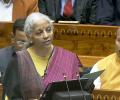
Budget 2026 sticks to fiscal discipline, shuns populist measures despite five key state elections coming up, but ends up rattling stock markets with a higher transaction tax on derivatives trading.
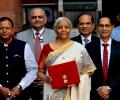
The Budget session of Parliament will be held from January 28 to April 2, featuring the President's address, the Economic Survey, and the presentation of the general Budget.

The Union Cabinet headed by Prime Minister Narendra Modi on Tuesday approved the full Budget for 2024-25, sources said.
This is the second Budget of the BJP-led NDA government in its third term in office.

Finance Minister Nirmala Sitharaman announced a fiscal deficit target of 4.3% of GDP for FY27, continuing the path of fiscal consolidation. The government aims to reduce the debt-to-GDP ratio to 55.6% by BE 2026-27 and further to around 50% by March 2031.

Finance Minister Nirmala Sitharaman will present her 8th straight Budget and all eyes will be on the much-expected tax relief for the middle class. Sitharaman had in her first Budget in 2019 replaced the leather briefcase -- which had been in use for decades for carrying Budget documents -- with a traditional 'bahi-khata' wrapped in red cloth.
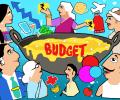
Finance Minister Nirmala Sitharaman on Tuesday presented the Budget for 2024-25, her 7th straight presentation surpassing the record of former prime minister Morarji Desai. This is the first Budget during Prime Minister Narendra Modi-led government's third term in office.

Finance Minister Nirmala Sitharaman on February 1 will present a record eighth consecutive budget that is expected to contain measures to shore up weakening economic growth and ease the burden on the middle class struggling with high prices and stagnant wage growth while being fiscally prudent.

These are the highlights of the Union Budget 2025-26 presented by Finance Minister Nirmala Sitharaman in Parliament on Saturday.

Nirmala Sitharaman presents the National Democratic Alliance government's budget amid high hopes and expectations from across the spectrum of society -- from farmers to industralist. Will the Budget fulfill the expectations of all?

Union Finance Minister Nirmala Sitharaman called upon 'Gen Z' and 'Gen Alpha' to assume leadership, prioritise the nation, and contribute to its growth, rather than questioning what the country has done for them.
Nirmala Sitharaman will present the budget of the second term of the Narendra Modi government today.

The Central Board of Indirect Taxes and Customs (CBIC) is set to significantly increase its use of artificial intelligence (AI), machine learning (ML), and real-time analytics in Customs processes, aiming for a near-touchless, near-digital clearance experience, according to Chairman Vivek Chaturvedi.

The Opposition on Tuesday termed the Union Budget as a 'kursi bachao budget' driven by political compulsions and claimed that it ignored opposition-ruled states in a bid to 'appease' Bharatiya Janata Party's allies.

The scenes are same; placards, viral videos, riot, police but the grievances could hardly be more different, notes Abhay Jere, ex-Vice Chairman, AICTE.
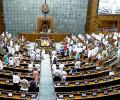
India's Monsoon session of Parliament remains formally unprorogued 40 days after adjournment, setting a new record. This unusual delay fuels speculation that the government intends to introduce a key legislation, possibly an amendment to the women's reservation law, without convening a new session. The proposed amendment aims for a 50 per cent seat expansion to address concerns over delimitation.
Watch as Nirmala Sitharaman unveils India's economic roadmap for the next fiscal year and beyond.

Union Minister Bandi Sanjay Kumar announced India's ambitious plan to rank among the top 10 sporting nations by 2036 and top five by 2047. He highlighted the central government's commitment to sports development through initiatives like Khelo India, increased budget allocation, and a special fund for sports equipment and technology, emphasising sports as a tool for nation-building and youth empowerment.
Union Minister Bandi Sanjay Kumar announced India's ambitious plan to rank among the top 10 sporting nations by 2036 and top five by 2047. He highlighted the central government's commitment to sports development through initiatives like Khelo India, increased budget allocation, and a special fund for sports equipment and technology, emphasising sports as a tool for nation-building and youth empowerment.
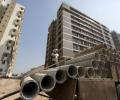
During 2023, the Indian real estate sector - both housing and commercial - witnessed buoyancy fuelled by demand, supply, and absorption, and the sector is banking on the upcoming Budget to keep the momentum going. Mumbai-based Sattva Group wants the government to focus on the critical pillars for long-term growth. The company emphasised on the infrastructure boom with increased allocation, lower goods and services tax (GST) rates, incentives for affordable housing and single-window clearance to fast-track projects and support liquidity.

Moody's Ratings has sharply increased India's GDP growth forecast for fiscal 2026-27 to 7 per cent, making it the fastest among G20 economies, driven by economic resilience despite the Middle East conflict. However, the agency flagged significant inflation risks stemming from elevated oil prices and potential El Nino disruptions.

New Delhi was told it had given something up; in reality it had stopped talking about it, notes Dr Abhishek Puri.

The Lokpal, India's anti-corruption ombudsman, has been allocated Rs 30 crore in the Union Budget 2026-27. The Central Vigilance Commission (CVC) has been allocated Rs 54.56 crore.

Will Finance Minister Arun Jaitley live up to the expectations of India Inc and individual taxpayers? Watch all the action here live from Parliament.

'Wages have not risen. Rural wages have stagnated. The growth was 0.7 per cent last year. For casual and irregular labour, the wage growth is negative.'

The health sector has been allocated Rs 89,155 crore in the Union Budget 2023-24, a hike of around 13 per cent over Rs 79,145 crore allocated in 2022-23, with the government also announcing a mission to eliminate sickle cell anaemia by 2047.

The Indian government's announcement of 10,000 additional seats in medical colleges next year, part of a plan to add 75,000 seats over five years, has been welcomed by education experts and stakeholders. The move aims to address the shortage of medical professionals and reduce the outflow of Indian medical students to other countries. The budget also includes infrastructure expansion at five new IITs to accommodate 6,500 more students and an allocation of Rs 500 crore to set up a Centre of Excellence in Artificial Intelligence for education.

Both Houses of Parliament were adjourned sine die, concluding a Budget session marked by the passage of key legislations and the defeat of a Constitution amendment bill on women's reservation. The session saw frequent opposition protests and discussions on various issues, including the West Asia conflict.

The Congress party has strongly criticized the Union Budget, calling it 'lacklustre' and 'disappointing,' claiming it fails to address the needs of farmers, unemployed youth, and other key sectors.

The first leg of the Budget session concluded with debates over the India-US trade deal and a former army chief's memoir, and will reassemble on March 9.
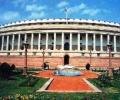
The sources also said that the Budget session of Parliament is likely to start from March 12.

The Union finance ministry has kicked off the exercise for preparation of the Union Budget for the fiscal year 2012-13 and has asked all ministries to rush proposals by October 31 for inclusion in the second supplementary budget for 2011-12 to be presented in the winter session of Parliament.
